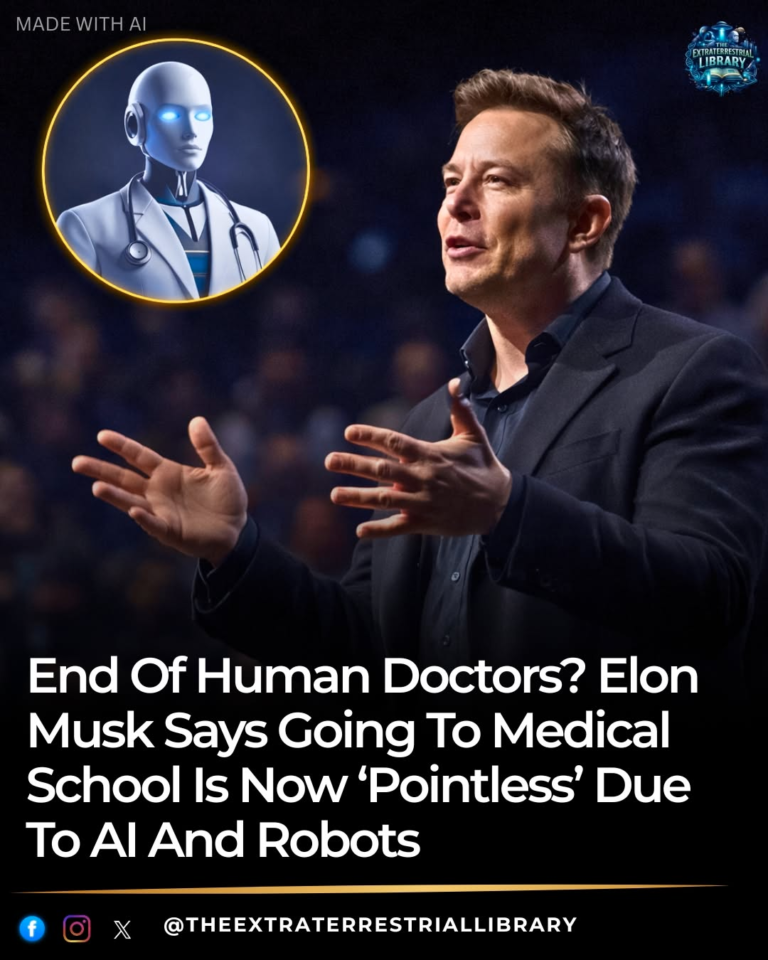
The Extraterrestrial Library explores Elon Musk’s predictions for robotic surgeons, the limits of automation and the future of medical training.






By The Extraterrestrial Library · Commentary · Supplied illustrations marked “Made with AI”
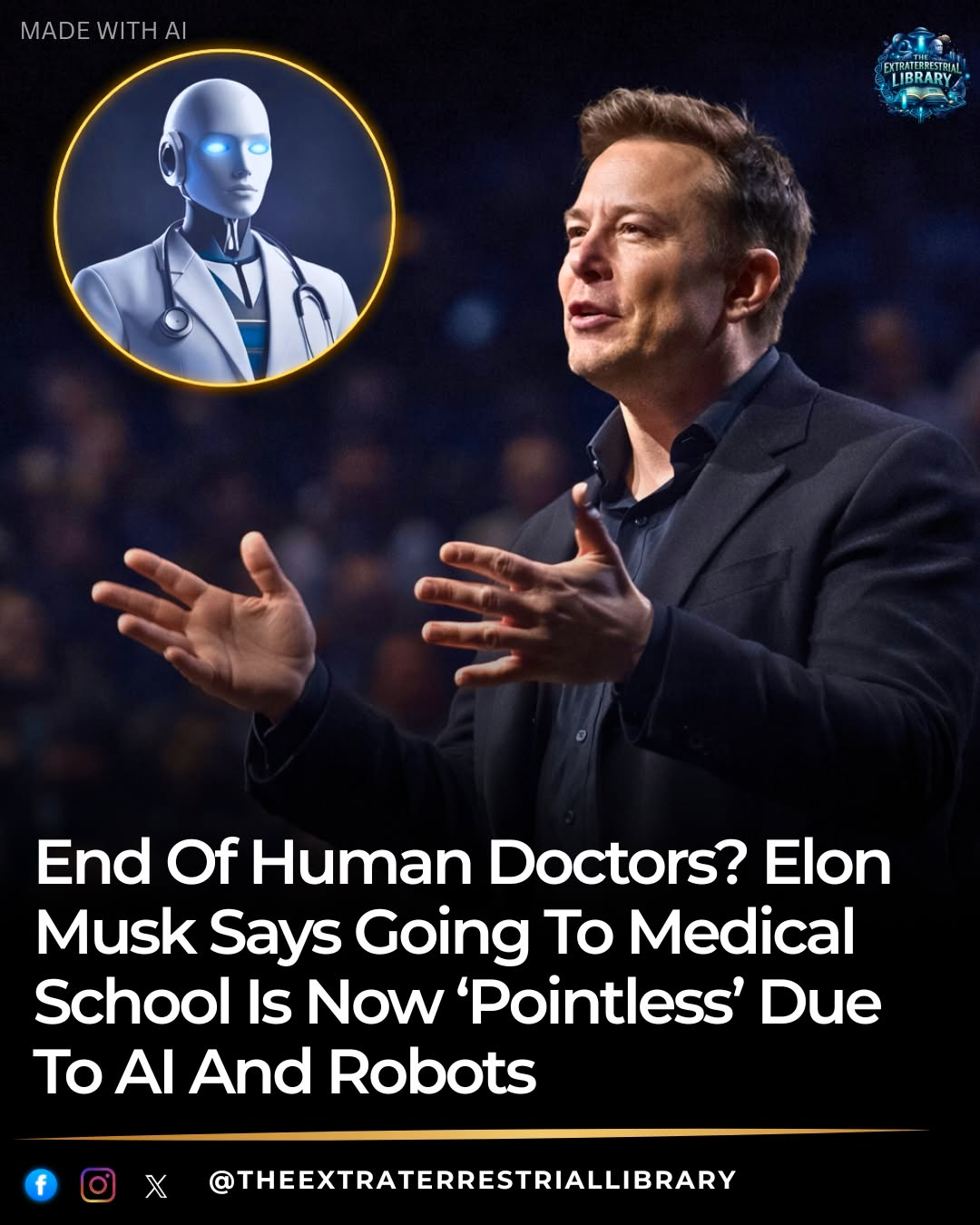
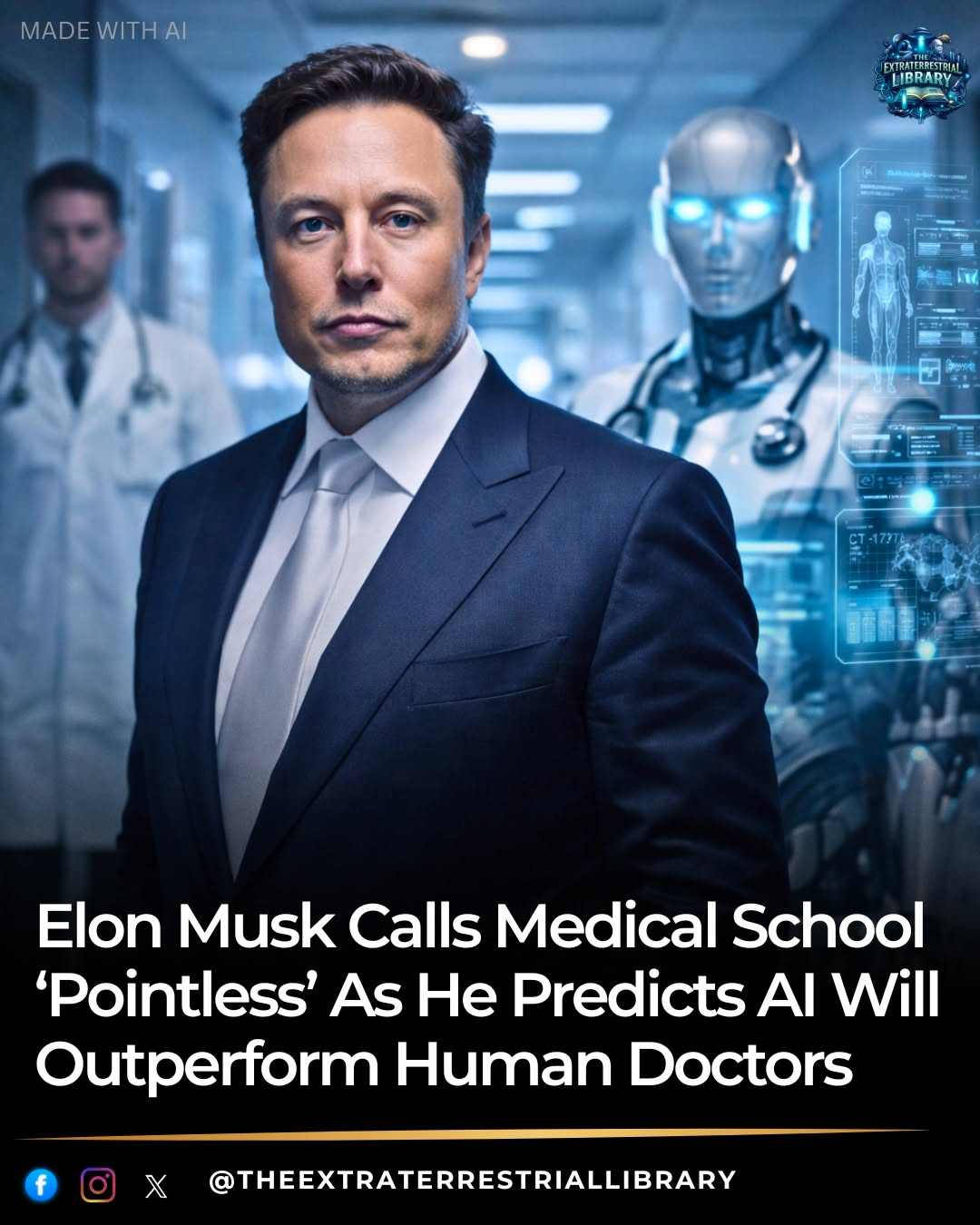
Elon Musk just told young people not to go to medical school — because robots will replace surgeons within three years.
Speaking on Peter Diamandis’s Moonshots podcast, Musk argued that the decade-long journey to becoming a skilled surgeon may soon become obsolete. His reasoning is brutally simple: medical training takes too long, doctors make mistakes, and the number of truly exceptional surgeons is limited. AI-powered robots, he claims, will soon perform procedures with precision no human hand can match. When Diamandis asked directly, "So don’t go to medical school?" Musk’s answer was one word: “Pointless."
He pointed to Neuralink’s surgical robot as evidence the future is already arriving. The machine implants brain-computer interfaces with a precision measured in microns — threading electrodes into neural tissue at speeds and accuracy levels beyond human capability. Musk sees this as the beginning, not the end. If a robot can perform brain surgery today, the argument goes, why wouldn’t robots perform all surgeries tomorrow? The technology only improves. Human hands don’t.
The claim has reignited fierce debate in medical and tech communities. Skeptics note that surgery isn’t just technical execution — it requires real-time judgment calls when unexpected complications arise, communication with conscious patients during certain procedures, and ethical decision-making that can’t be reduced to algorithms. A robot can be programmed to perform a specific operation flawlessly. But can it decide when not to operate? Can it recognize when a patient’s condition has changed mid-procedure in ways the pre-surgical imaging didn’t predict? Can it weigh quality of life considerations that have no objective right answer?
Defenders of Musk’s timeline argue that skeptics consistently underestimate how quickly AI capabilities compound. Five years ago, the idea of AI passing medical licensing exams seemed distant. Today, large language models score in the top percentiles. Robotic surgical systems already assist in hundreds of thousands of procedures annually, and their precision metrics often exceed human benchmarks. The question isn’t whether robots will eventually outperform surgeons in certain domains — it’s whether "eventually" means three years or thirty.
There’s also the access argument. The world doesn’t have enough skilled surgeons, especially in developing nations where patients die from treatable conditions simply because no qualified hands are available. If robotic surgery can be deployed at scale — machines that don’t need sleep, don’t burn out, and can operate in remote locations with satellite guidance — the democratization of surgical care could save millions of lives. The ethics of withholding that technology to protect human jobs becomes complicated when the alternative is preventable death.
But telling eighteen-year-olds that medical school is pointless carries real consequences. Medical education pipelines take a decade to produce practicing physicians. If talented students abandon medicine based on predictions that prove wrong — or prove right but on a longer timeline — healthcare systems could face catastrophic workforce shortages precisely when aging populations need more care. Musk has made bold predictions before. Some have proven visionary. Others have missed their timelines by years. Betting your career on which category this falls into is a gamble most students can’t afford to get wrong.
The deeper question isn’t whether AI will transform surgery — it will. The question is whether transformation means replacement or augmentation. Radiologists were supposed to be obsolete by now. Instead, AI helps them work faster and catch more anomalies. The technology didn’t eliminate the profession; it changed what the profession does. Surgery might follow the same pattern: robots handling the mechanical execution while human surgeons manage complexity, judgment, and the irreducibly human elements of medicine.
Or Musk might be right, and we’re three years from a world where the best surgeon on Earth is made of metal.
Either way, someone entering medical school today will find out before they graduate.