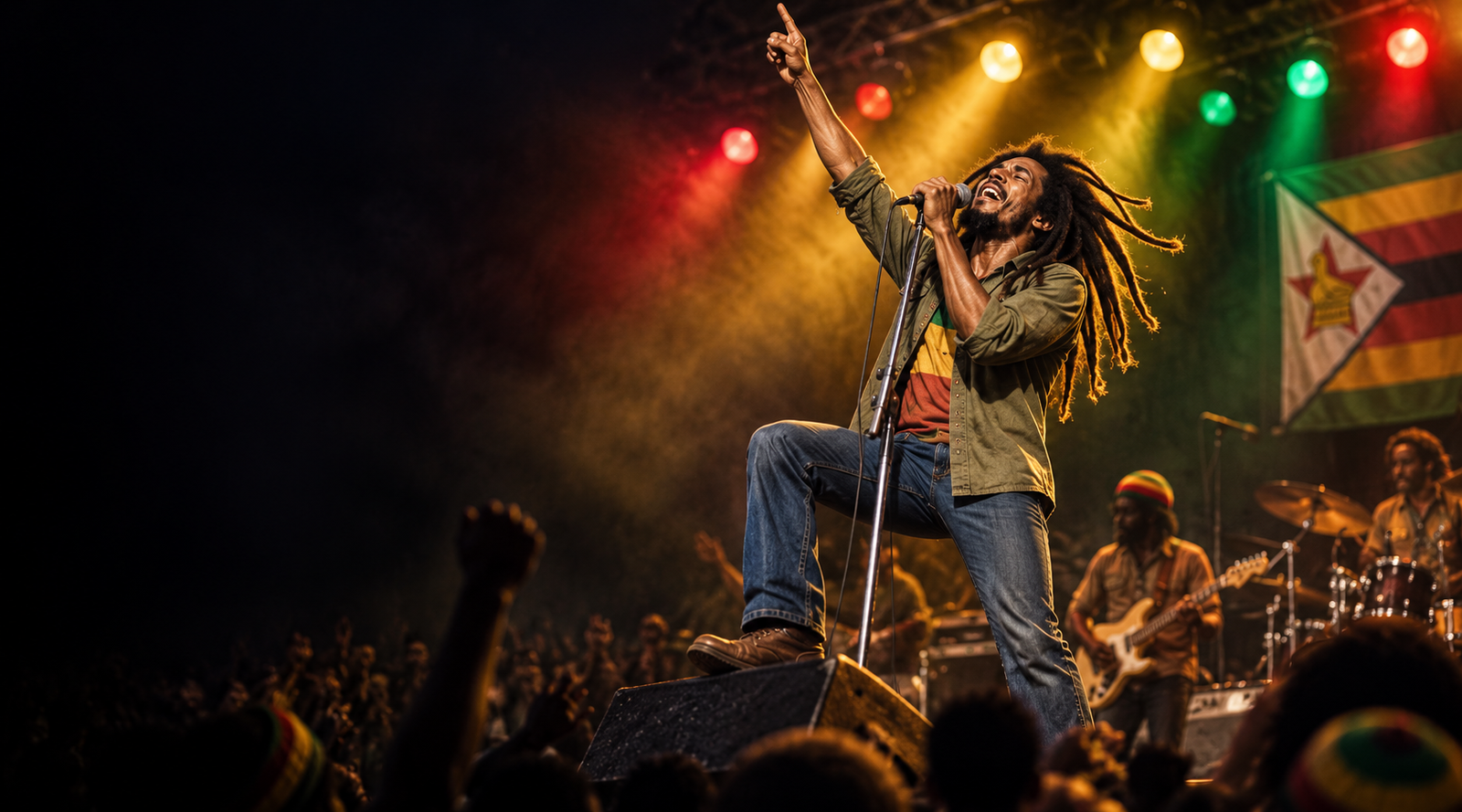
Bob Marley reportedly went to extraordinary lengths to perform at Zimbabwe’s independence celebrations,
personally helping bring his band, crew and equipment to Harare for a historic performance centered on
freedom, solidarity and his anthem “Zimbabwe.”
Bob Marley’s Journey to Zimbabwe Was About More Than Music
Bob Marley’s connection to Zimbabwe was never simply about performing another concert.
According to accounts surrounding the historic appearance, Marley went to remarkable lengths
to ensure that he and his band could be present as the country marked a defining moment in its history.
He reportedly arranged transportation from London to Harare not only for himself,
but also for members of his band, crew and essential stage and sound equipment.
For Marley, the occasion represented something much larger than entertainment.
A Major Personal Commitment
The trip was reportedly a substantial financial undertaking.
Some accounts have suggested that the total cost of transporting the musicians, crew and equipment
ran into the hundreds of thousands of dollars, with figures sometimes cited as high as
$500,000.
Whatever the exact figure, the point remains clear: Marley was willing to make a significant
personal commitment to be part of the occasion.
The performance itself was presented without the usual commercial focus associated with a major international artist.
“Zimbabwe” Had Already Become an Anthem
Marley had released “Zimbabwe” on his 1979 album Survival.
The song was rooted in themes of liberation, self-determination and African unity,
and it became closely associated with the struggle against colonial rule.
By the time Marley arrived in Zimbabwe, the song already carried meaning far beyond the recording studio.
It had become a symbol of the political and cultural moment surrounding the country’s transition to independence.
When a Song Met History
Performing “Zimbabwe” during the independence celebrations gave the track an entirely different weight.
What had once been a song about liberation was now being performed in front of people witnessing
that liberation become reality.
For many, that is what made the moment so powerful.
The music was no longer commenting on history from a distance — it was being performed in the middle of it.
Bob Marley Saw Music as a Mission
Marley’s career was defined not only by reggae, but by the way he used music to speak about
freedom, inequality, identity and unity.
His appearance in Zimbabwe reflected that philosophy.
Rather than approaching the event purely as a business opportunity, the story surrounding the performance
portrays Marley as someone who believed his music had a responsibility to connect with movements and people beyond the stage.
That sense of purpose remains one of the reasons his work continues to resonate decades later.
A Moment That Became Part of His Legacy
Bob Marley’s performance in Zimbabwe remains one of the most memorable examples
of music intersecting with a major historical event.
It brought together reggae, African liberation and a newly independent nation
in a moment that was bigger than a traditional concert.
Decades later, “Zimbabwe” still stands as a reminder of how deeply Marley connected
his music with ideas of freedom and self-determination.
Do you think Bob Marley’s political and cultural impact was just as important as his musical legacy?